There is a moment on certain trails in Nepal when walking simply stops being enough. The trekking poles get swapped for an ice axe, the sneakers get replaced with crampons, and a rope gets tied between you and the person walking next to you. It is a different kind of trip altogether, one that asks considerably more of the body and gives back a view that very few people ever get to stand in front of.
The Last Stretch Before a Summit
Photos from the final push toward a snow summit rarely capture how loud the wind actually is, or how much concentration it takes to place each step correctly on a slope like that. In one shot, two climbers kneel together near the top of a ridge, roped in, an ice axe planted in the snow beside them, with a scatter of tiny figures visible on the summit ridge further ahead. Their faces show that particular mix of exhaustion and disbelief that shows up on almost everyone during the final hour of a climb like this.
This is the part of mountaineering nobody quite prepares you for emotionally. The physical training matters, the gear matters, but nothing fully readies you for how strange it feels to be standing on a slope this high, roped to a stranger or a friend, both of you trusting the same knot to keep you safe. Peaks like Island Peak or Mera Peak in the Everest region draw climbers precisely for this reason. They offer a real taste of high altitude mountaineering without requiring the technical skill or expedition scale of the true giants nearby.
The View That Makes the Climb Worth It
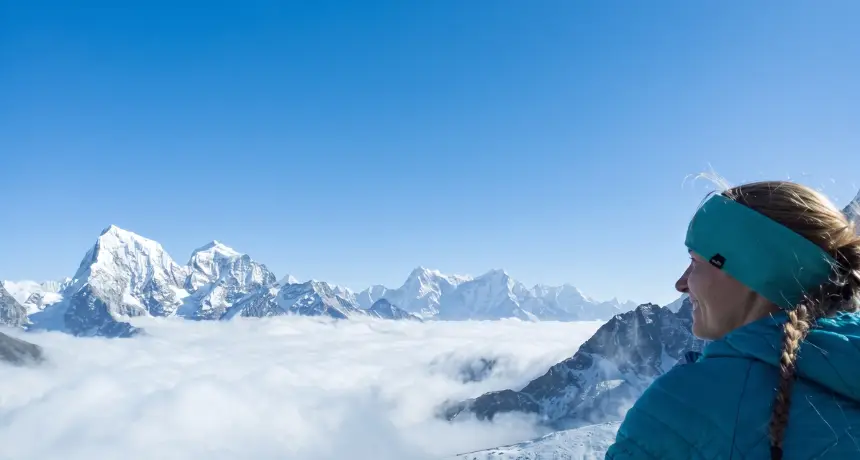
Above a certain altitude, the clouds stop being something you look up at and start being something you look down on instead. In one image, a climber stands at the edge of a ridge, hair pulled back under a headband, watching a sea of white cloud roll beneath a line of jagged snow peaks. The sky above is a deep, cloudless blue, the kind that only shows up at real elevation, where the air has thinned out enough to lose its haze entirely.
Moments like this tend to go quiet fast. There is not much to say when you are looking down at a cloud layer from above, with an entire range of the world's highest mountains cutting through it. Places like Gokyo Ri and Kala Patthar in the Everest region are known for exactly this kind of view, reachable without technical climbing gear but demanding enough in their own right, with early starts in freezing temperatures rewarded by a panorama that photographs never quite do justice.
Why People Keep Chasing This Feeling
It would be easy to assume high altitude trekking and climbing in Nepal is only about ticking off summits and viewpoints, but talk to anyone who has done it more than once and a different pattern emerges. It is rarely about the summit itself. It is about the version of yourself that shows up on the mountain, tired, cold, breathing harder than usual, and still choosing to take the next step anyway.
The Himalayas have a way of stripping a trip down to its essentials. No wifi, limited comfort, unpredictable weather, and yet people return to Nepal's mountains again and again. Somewhere between the effort of the climb and the silence of a view like the ones in these photos, something about the experience becomes difficult to leave behind for good.
Season FAQs
Trekking peaks like Island Peak and Mera Peak involve glacier travel, fixed ropes, crampons, and an ice axe, but do not require advanced mountaineering skills. Technical climbing on higher peaks involves far more complex terrain, rock and ice climbing skills, and significantly more risk and preparation.
Prior trekking experience at high altitude is essential, and some basic training with crampons and an ice axe is strongly recommended before attempting a peak like this. Many climbers take a short mountaineering training course in Nepal before the climb itself, and going with an experienced guide is standard practice rather than optional.
Beyond standard trekking gear, climbers need crampons, an ice axe, a climbing harness, a helmet, and appropriate ropes, all of which are usually arranged through the expedition operator. Layered high altitude clothing, insulated gloves, and proper eye protection against snow glare are also essential.
Both are demanding but non technical viewpoints, reachable on foot without climbing gear. The difficulty comes mainly from the altitude and the early, cold starts required to catch clear morning views, rather than from the terrain itself.
Pre monsoon spring, from March to May, and post monsoon autumn, from late September to November, offer the most stable weather and clearest visibility for both trekking peaks and viewpoints like Gokyo Ri and Kala Patthar.